Research
Network Architecture and Routing
Routing is a key mechanism for efficiently delivering packets to their appropriate destinations in a network. Network architectures vary widely, from the entire Internet to carrier networks of Internet service providers, large-scale data center networks, mobile networks like 5G, and campus networks in enterprise environments. Each type has its unique technical requirements and challenges. We are working on addressing challenges and advancing capabilities across these diverse network environments.
Measuring the Potential Benefit of Egress Traffic Engineering
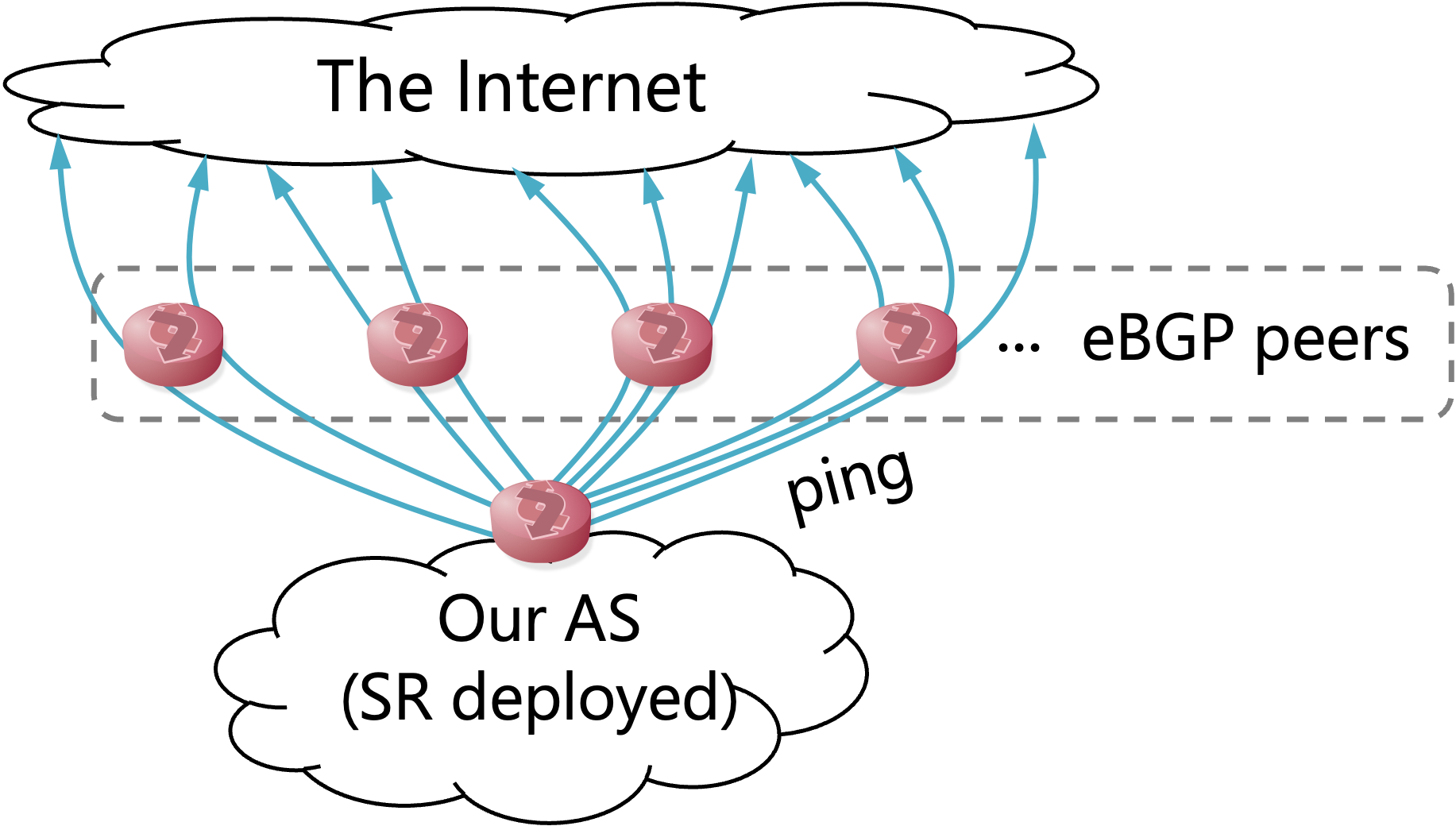
The Internet is composed of independent networks called Autonomous Systems (ASes). ASes exchange their routes (AS paths) with each other using Border Gateway Protocol (BGP), and each AS selects an AS path for every destination network.
When there are multiple paths from one AS to another, the path BGP selects is not always the best in terms of performance, for example latency or bandwidth. In an experiment conducted on Interop Tokyo ShowNet (AS290) in 2021, we showed that for 77% of destination networks have AS paths with lower latency than their BGP best path.
Data Center Load Balancing with Segment Routing over IPv6
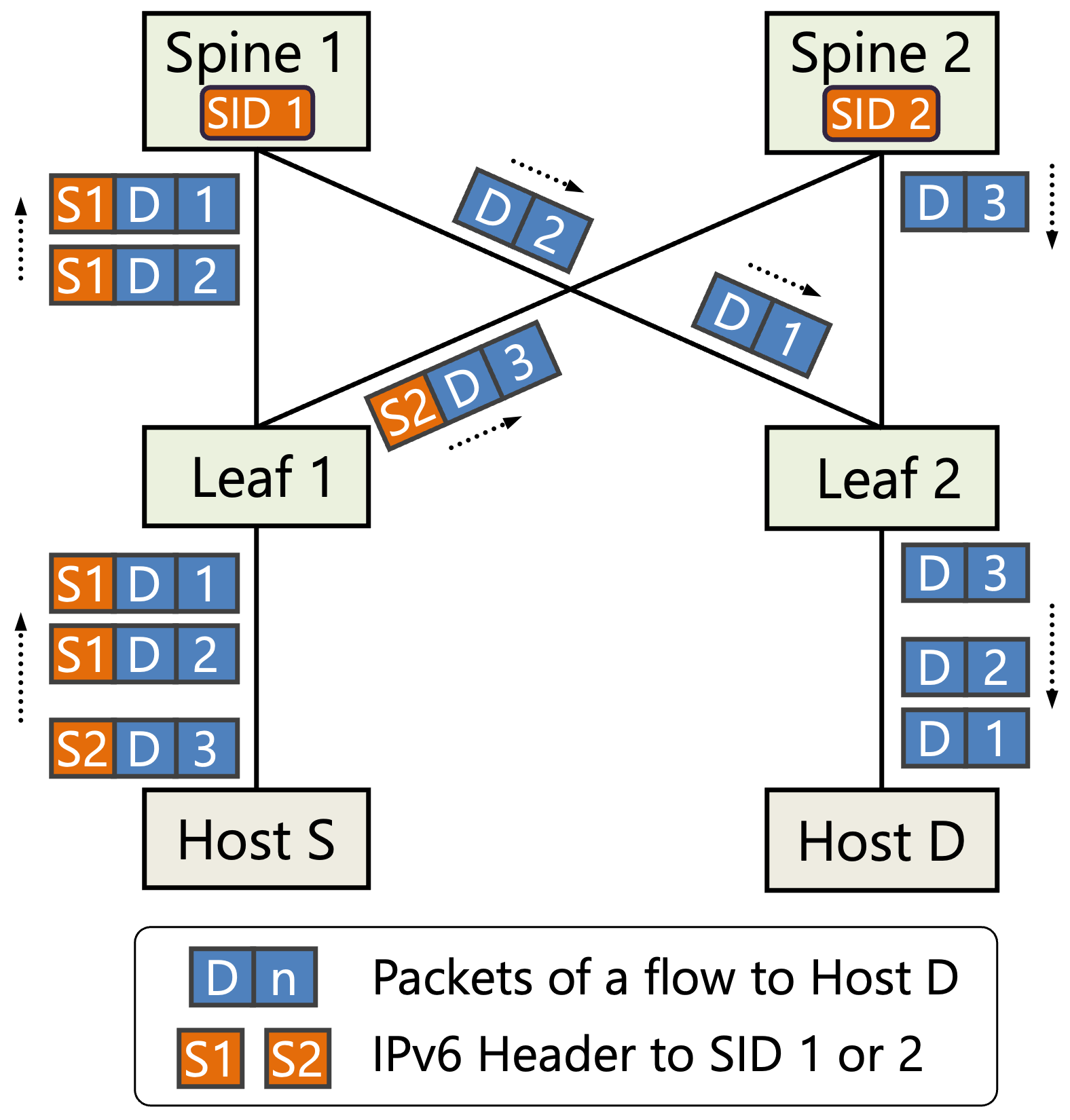
In a data center network built from a large number of servers and network switches, how to distribute load is an important issue. The load here can be traffic, requests to be processed, or computation.
We have developed load balancing methods that apply Segment Routing over IPv6. Examples are a stateless L4 load balancer built with hardware routers, and how to spread traffic as evenly as possible over the multiple paths that a large number of switches provide. Both take the same approach: exploiting the property of SRv6 that the sender can specify the path a packet takes, so that the network side does not have to keep state.
Other publications in this area
- IP-Native User Plane Control for Decentralized Mobile Systems, 2026
- An Experiment of SRv6 Service Chaining at Interop Tokyo 2019 ShowNet, 2019
System Software and Network Subsystem
Computers that send and receive packets over networks, more specifically peripheral devices such as Network Interface Cards and packet processing by the Operating System (Network I/O), are also our research targets. We are working on research that improves usability and performance through functionality additions at both OS and application levels.
Multi-threaded scp: Easy and Fast File Transfer over SSH
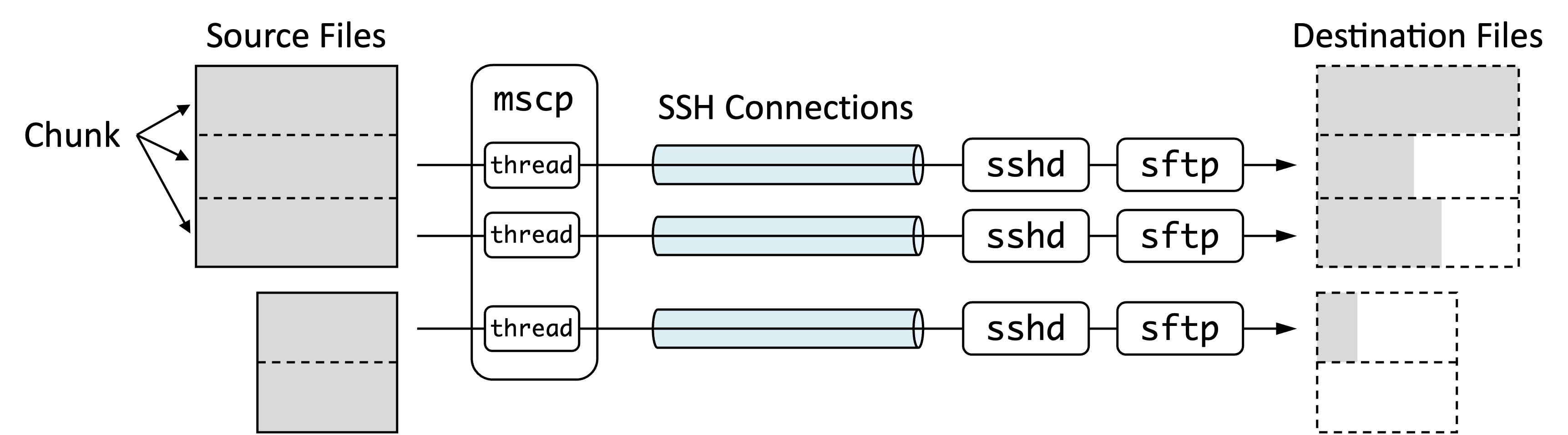
Transferring a large amount of data over a network, and doing so faster, is an indispensable operation in computer science and in many other fields. We develop mscp, a tool that makes fast data transfer easy. By transferring data in parallel over multiple SSH connections, mscp achieves high-speed file transfer with the same usability as the ordinary scp command. mscp is maintained as open source software and runs on Linux and macOS.
Other publications in this area
- Pktpit: Separating Routing and Packet Transfer for Fast and Scalable Software Routers, 2022
- NetTLP: A Development Platform for PCIe devices in Software Interacting with Hardware, 2020
Network Operation
The Internet is supported by the continuous efforts of network operators around the world.
Every day, somewhere, someone investigates and fixes network troubles, plans for the future, expands as needed, and performs daily operations. We are also working on research to make network operations easier.
How Helpful is LLM Assistance in Network Operations?
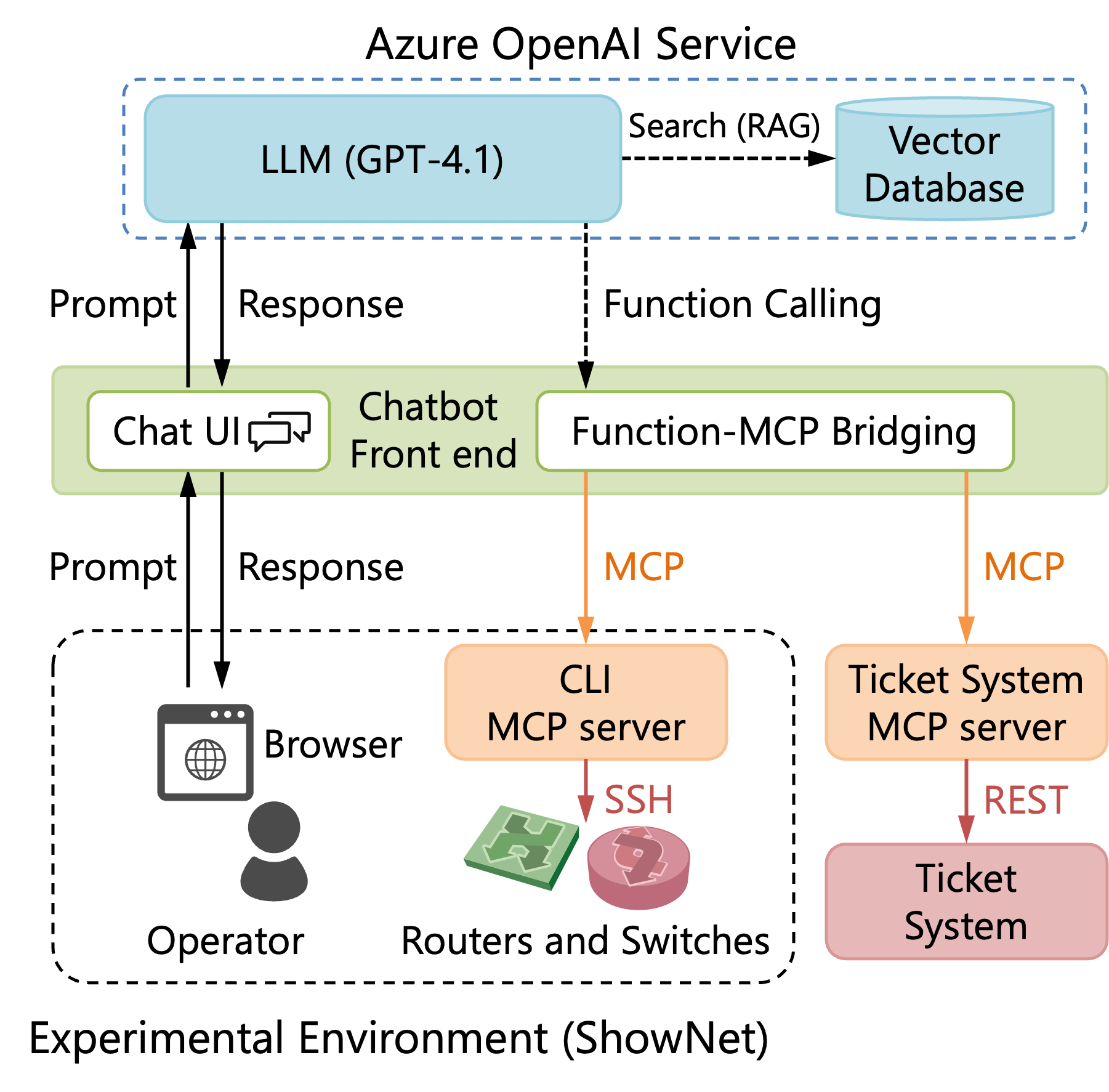
How helpful a Large Language Model (LLM) is in network operations varies with the model, the environment, the people who use it, and the harness around it, including the tools available to the LLM.
In this work, we built an LLM-based chatbot specialized for building and operating networks, and had more than 100 network engineers actually use and evaluate it while building and operating Interop Tokyo ShowNet in 2025.